


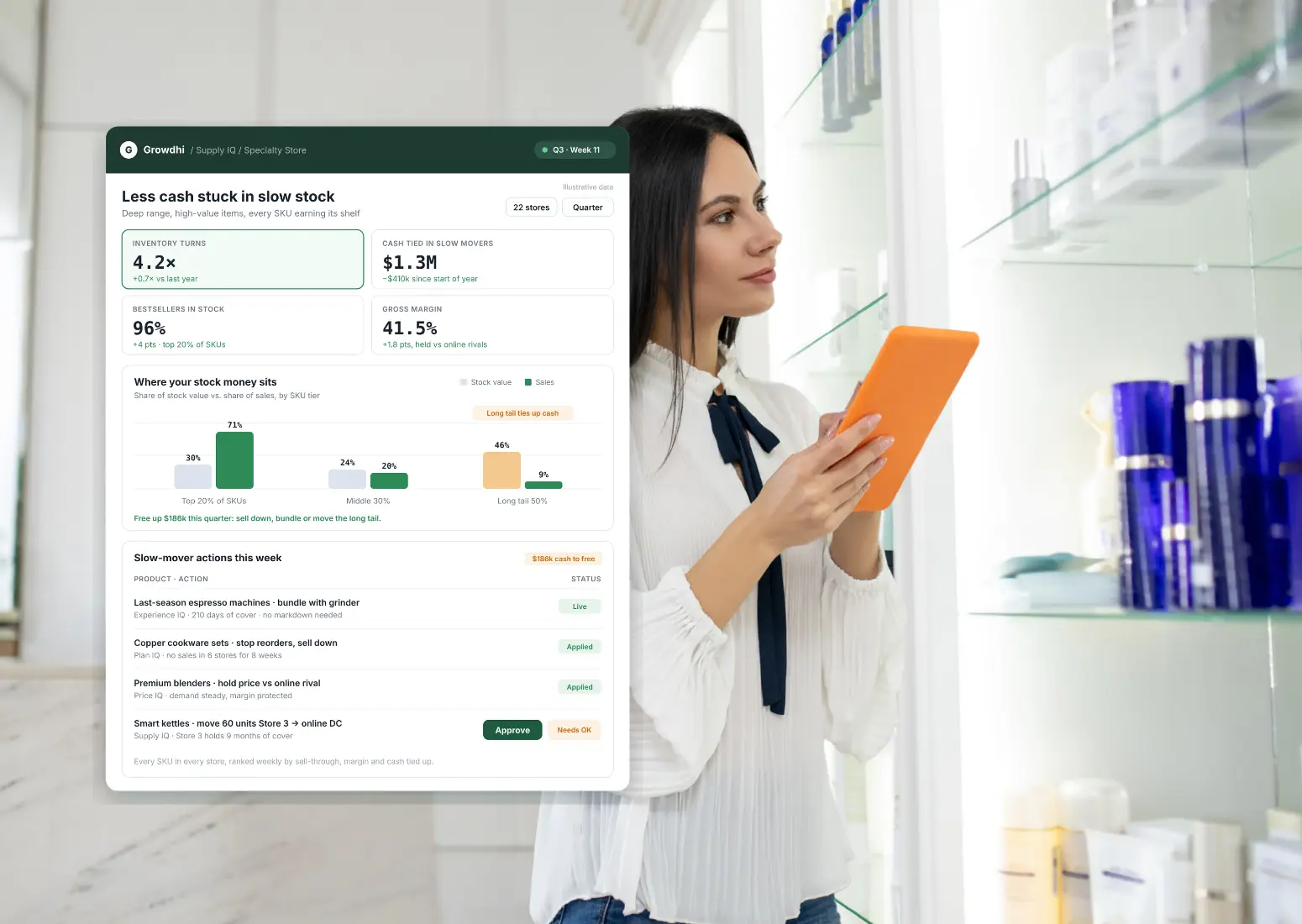

Slow sellers forecast like fast ones
Many products sell one or two units a week. Average-based forecasts misread that pattern, so stores end up overstocked or empty.
Specialty margin leaks quietly, because most products sell only a few units at a time and averages hide what is really happening. The same problems repeat in almost every specialist business, whatever the category or store size.
Many products sell one or two units a week. Average-based forecasts misread that pattern, so stores end up overstocked or empty.

An item sits untouched in one store while shoppers ask for it in another. Without a clear view, nobody moves it.

Specialty prices are easy to compare online. Matching everything erodes margin, while ignoring key items costs sales and credibility.

Shoppers buy from specialists for advice. Online, their questions often go unanswered, so they leave to research elsewhere.

The main product sells, but the accessories, refills, and add-ons that carry the best margins rarely make it into the basket.
Specialty decisions are many and detailed: thousands of products, each with its own pace and price point. Growdhi’s AI agents handle them daily, product by product, within the rules you set.

| Product | Decision | Handled by | Cadence |
|---|---|---|---|
| Plan IQ | Which products will sell, and where |
|
Daily |
| Supply IQ | When to restock slow and fast sellers |
|
Daily |
| Which stores should hold each item |
|
Continuous | |
| How each order ships, from store or warehouse |
|
Per order | |
| Price IQ | Where to match the market, and where to hold |
|
Continuous |
| Which offer goes to which customer |
|
Per customer | |
| When to clear aging stock, and how deep |
|
Per SKU, per week | |
| Experience IQ | What each shopper sees, finds, and is advised |
|
Real time |
| Growth IQ | Which customers matter most, and who’s slipping away |
|
Nightly |

Growdhi identifies which stores actually sell each long-tail item, so depth goes where demand is and slow stock stops spreading thin.

AI times orders for slow sellers around long supplier lead times, so items arrive before shelves empty, without piling up.

AI keeps your most-compared products competitive with marketplaces and protects margin on lines where your range and advice set you apart.

Staples that shape price perception stay sharp against competitors, with a person approving each one, while margin is earned across the rest of the basket.

AI spots items sitting too long and plans markdowns or store transfers early, before they need a deep cut.

When systems disagree on stock, AI flags the gap before shelves sit empty, ranking the items with the most sales at risk first.

AI learns which accessories customers buy with each product and suggests the right ones before checkout.

AI answers technical questions about specifications, compatibility, and use, and hands complex cases to your specialists.

AI flags high-value customers who are buying less, matches each with the right reason to return, and personalizes what they see next.

AI aims offers at new and lapsing customers instead of loyal ones who’d pay full price, so promotions add sales instead of giving margin away.
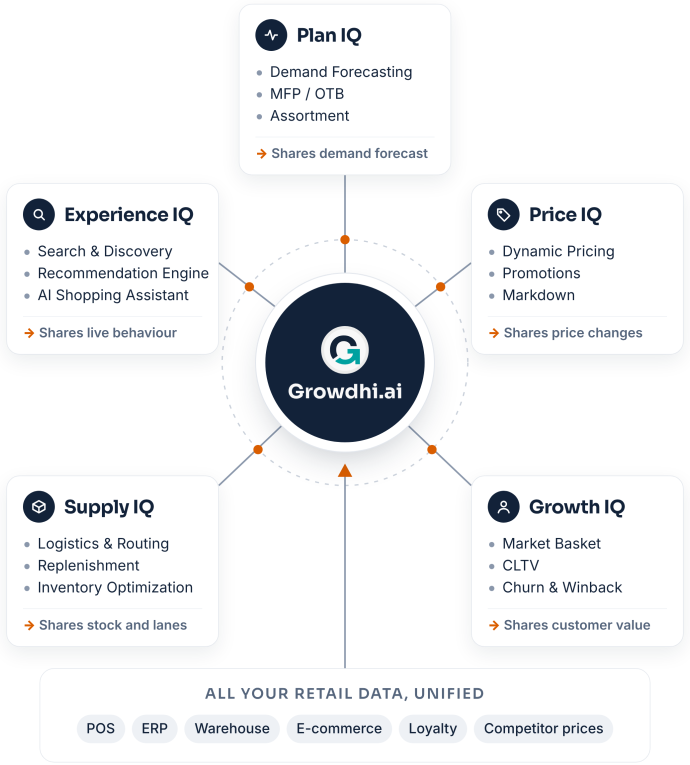
A pricing tool, a forecasting tool and a promo tool can each be good on their own. The margin is lost in the gaps between them.
Without
 With
 The right products sit in the right stores, with answers online, so fewer sales walk away.
Prices stay sharp where shoppers compare and firm where your expertise counts.
Range depth follows demand, so cash isn’t locked in items that won’t sell.
Each order ships from the best location, with the right carrier for the job.
Shoppers get expert answers and the right add-ons, in store and online.
AI spots valuable customers slipping and brings them back with the right offer.
Five IQ domains share one signal layer and one Policy Engine, delivered as a dedicated instance for your brand and built to clear enterprise security review.
Your data runs in an instance isolated to your brand. Single sign-on, role-based access and logged access events protect pricing, supplier and customer data.
The Policy Engine applies your pricing, discount and data rules to every decision before it runs, with regional compliance built into each deployment and one audit trail.
Independently audited against recognised standards. Reports are available to your security and procurement teams on request.
A space to explore ideas, spark perspectives, and turn curiosity into clarity. Where thinking evolves into meaningful insights that guide smarter decisions.

 Blog
Every fashion retailer commits money to product months before it knows what customers will buy. This guide explains how fashion margin is made and lost, how business models place that bet, and how leaders use AI in 2026.
Read Article Blog
Grocery is the one retail segment where a bad decision can expire before anyone reviews it. Margins run at a few cents on the dollar, fresh stock lasts days, and shoppers return every week to test whether the store still delivers value. Most enterprise grocers already own capable systems for forecasting, pricing, ecommerce and loyalty. […]
Read ArticleFind quick answers to common questions about our solutions, features, and capabilities. Everything you need to understand how it works and how it helps your business.
AI forecasts demand for each product in each store, including items that sell only a few units, so depth goes where it sells and slow stock stops tying up cash across the network.
Yes, on the products shoppers actually compare. AI keeps those prices competitive and protects margin on the lines where your range and expertise justify a stronger price.
Yes. The AI Shopping Assistant answers questions about specifications, compatibility, and use from your product information, and passes complex cases to your specialists.
Yes. You choose which decisions AI handles and the rules it follows, and your team can review, approve, or reverse any action.
No. Growdhi connects to your POS, ERP, warehouse, and ecommerce data, so your teams keep the systems they already rely on.


