


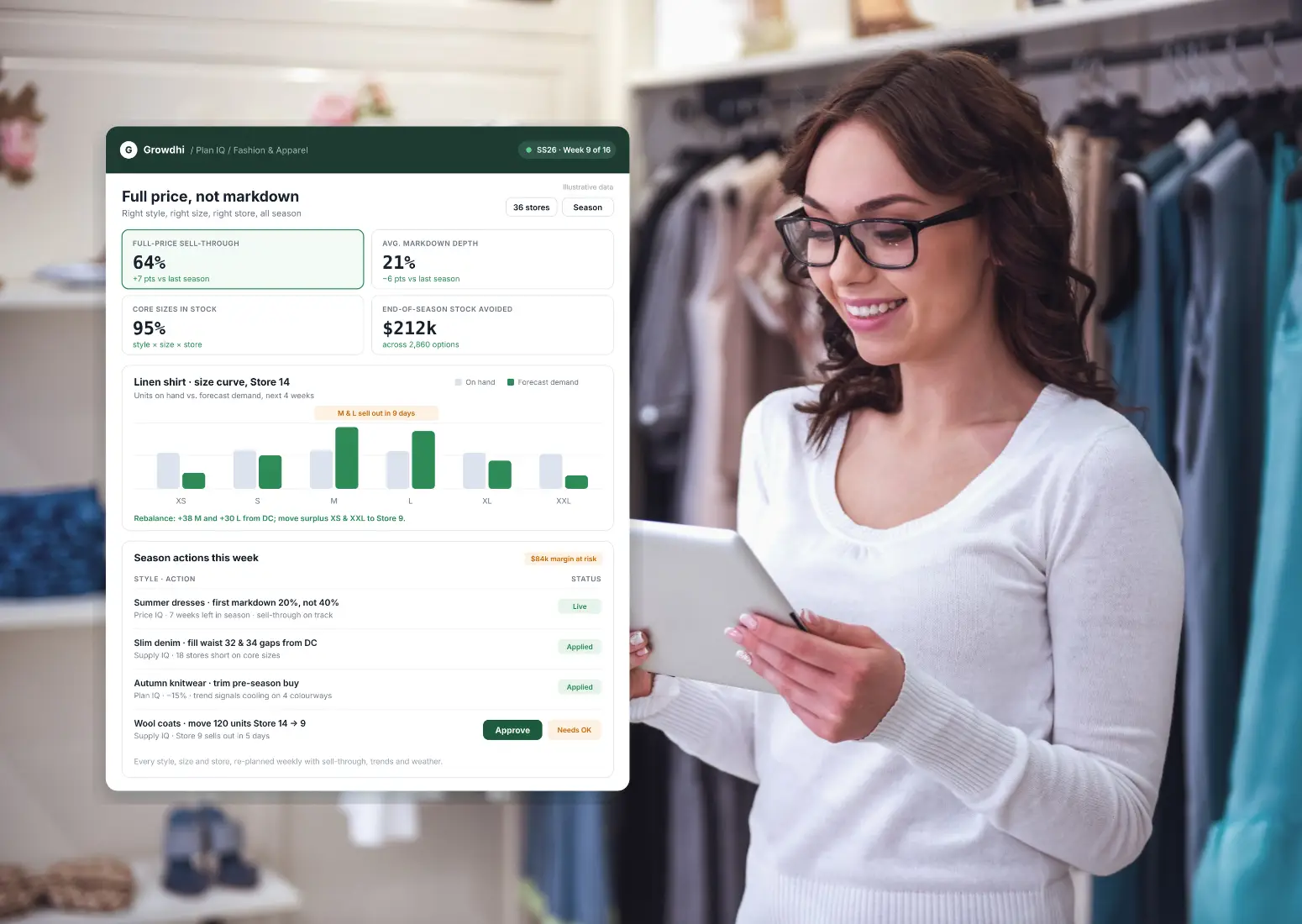

The markdown that comes too late
Popular sizes sell out while others sit on the rack. By the time you notice the gap, the entire style needs a deeper discount.
Fashion margin rarely disappears in one bad call. It leaks in the same five places, because thousands of decisions are made late, alone, or on last year’s numbers. That is exactly the work agentic AI now does better.
Popular sizes sell out while others sit on the rack. By the time you notice the gap, the entire style needs a deeper discount.

Orders are placed months ahead using past sales, but new styles have no history to show what customers will actually want.

Best sellers run out during holidays, launches, and sales, while the same products remain unsold in other stores.

Promotions drive sales, but discounts often go to customers who would have bought at full price anyway.

Regular customers start buying less often as their preferences change, but the business may not notice until repeat sales decline.
Growdhi brings AI into the decisions that shape a fashion business, helping teams see what is changing, understand what needs attention, and act across the season.

| Product | Decision | Handled by | Cadence |
|---|---|---|---|
| Plan IQ | What will sell, by SKU and store |
|
Daily |
| Supply IQ | When to reorder and how much |
|
Daily |
| Where stock should sit |
|
Continuous | |
| How to ship it |
|
Per order | |
| Price IQ | What price to hold or change |
|
Continuous |
| Which offer, to whom, on what channel |
|
Per customer | |
| When and how deep to clear |
|
Per SKU, per week | |
| Experience IQ | What to show, suggest and say |
|
Real time |
| Growth IQ | Who’s worth keeping, who’s leaving |
|
Nightly |
The fashion decisions that move margin most, each handled by agents working from the same signals.

When popular sizes sell out and the rest linger, AI discounts only the leftovers, so everything still selling keeps its full price.

AI predicts demand for holidays, launches, and sale events, reorders in time for suppliers to deliver, and puts stock where shoppers will look first.

Brand-new designs have no sales history. AI learns from similar styles you’ve sold before, so your first order is a forecast, not a gamble.

AI shows which promotions won new sales and which just discounted sales you’d have made anyway, then matches each shopper with the right offer.

Everyday prices, promotions, and clearance work from a single plan, so no product gets cut from three directions at once.

AI learns what shoppers buy together and suggests the pieces that complete the outfit, starting with the pairings that earn you the most.

When a top customer starts buying less, AI notices, chooses the right way to win them back, and personalizes their very next visit.

AI understands searches by occasion, color, and size, suggests smart alternatives when nothing matches, and guides shoppers to the right piece like a stylist would.
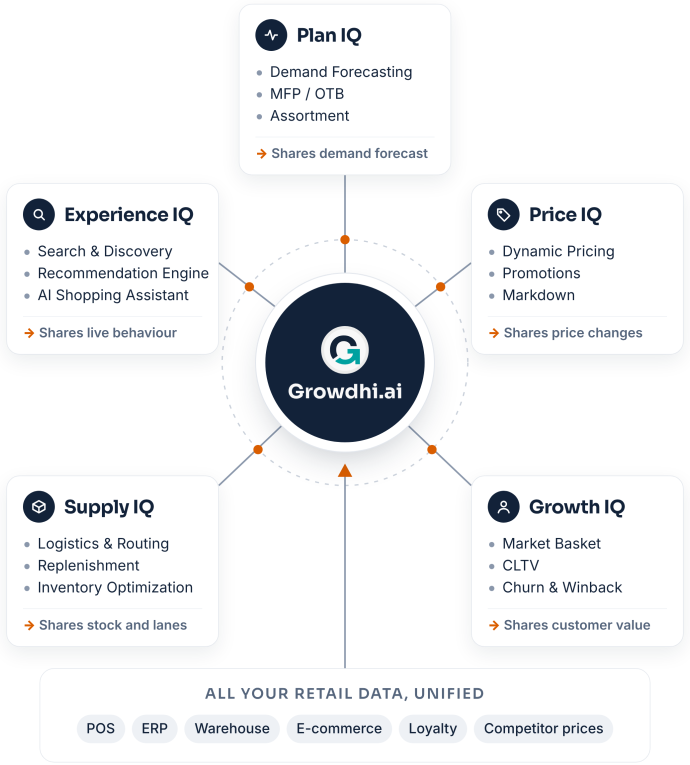
A pricing tool, a forecasting tool and a promo tool can each be good on their own. The margin is lost in the gaps between them.
Without
 With
 The right styles stay in stock where shoppers want them, so fewer sales walk away.
Discounts land only where they’re needed, so more of every collection sells at full price.
Stock follows demand, so less cash is locked in products that won’t sell.
Each order ships the most efficient way, and AI handles the daily decisions your team used to chase.
Shoppers find their size, their style, and the right suggestion, online and in store.
AI spots who’s worth keeping and brings them back before they’re gone.
Five IQ domains share one signal layer and one Policy Engine, delivered as a dedicated instance for your brand and built to clear enterprise security review.
Your data runs in an instance isolated to your brand. Single sign-on, role-based access and logged access events protect pricing, supplier and customer data.
The Policy Engine applies your pricing, discount and data rules to every decision before it runs, with regional compliance built into each deployment and one audit trail.
Independently audited against recognised standards. Reports are available to your security and procurement teams on request.
A space to explore ideas, spark perspectives, and turn curiosity into clarity. Where thinking evolves into meaningful insights that guide smarter decisions.

 Blog
Every fashion retailer commits money to product months before it knows what customers will buy. This guide explains how fashion margin is made and lost, how business models place that bet, and how leaders use AI in 2026.
Read Article Blog
Grocery is the one retail segment where a bad decision can expire before anyone reviews it. Margins run at a few cents on the dollar, fresh stock lasts days, and shoppers return every week to test whether the store still delivers value. Most enterprise grocers already own capable systems for forecasting, pricing, ecommerce and loyalty. […]
Read ArticleFind quick answers to common questions about our solutions, features, and capabilities. Everything you need to understand how it works and how it helps your business.
AI acts on demand while it’s still changing. It catches slow sellers and broken size runs early, moves stock to where it will sell, and targets discounts only where they create new sales, so more of each collection sells at full price.
Yes. AI learns from similar past styles and their attributes, so new collections get a usable forecast from the first day instead of a guess.
AI forecasts demand for each peak weeks in advance, times reorders around supplier lead times, and positions stock in the stores and channels that will need it most.
Only where you allow it. You choose which decisions AI takes on, every action follows your rules, and any decision can be rolled back.
No. Growdhi connects to your existing POS, ERP, warehouse, and ecommerce data, so your teams keep the tools they already use.


