



Real Product Pairings
Assumed pairings often miss. You see the combinations customers actually buy together.
Market Basket Analysis
Your sales data already shows which products belong together. Market Basket Analysis by Growdhi turns those patterns into bundles, cross-sells, and offers that grow each basket.
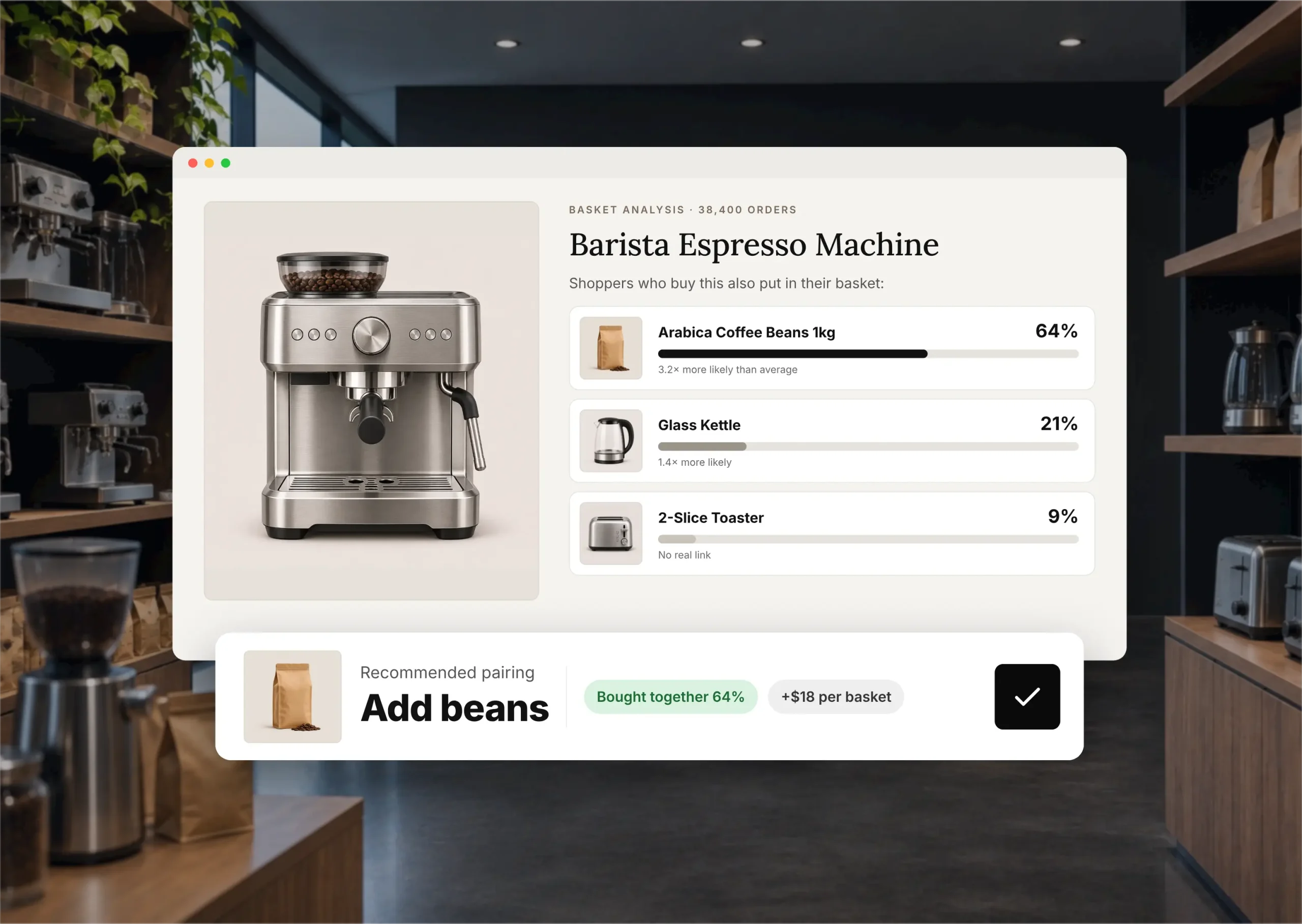
Cross-selling usually runs on instinct. Bundles get built because two products seem to belong together, and recommendations pair items a merchandiser assumes will appeal. Some combinations work. Many don’t, and a few quietly hurt sales by pairing products shoppers never buy side by side. Meanwhile, the strongest pairings in your data go unused, because nobody has time to dig through millions of transactions to find them. Baskets end up smaller than they need to be, and promotions miss the combinations shoppers actually want.
Market Basket Analysis, one of Growdhi’s three Growth IQ agents, finds those combinations for you. It studies your transactions and the market to measure how often products are bought together and how much more likely one purchase makes another, a measure known as lift. It also flags pairings that don’t work, so you stop recommending them. Before you launch a bundle, it predicts the likely lift and revenue. Its findings then feed the Recommendation Engine and Promo Optimization, so what you suggest and what you discount both reflect how customers really shop.
A bundle that looks right on paper can still fall flat. You decide which bundles to consider, and Growdhi shows how each one is likely to perform.
Compare bundle options by expected lift and revenue, check the margin on each combination, and set limits so suggestions never feel pushy. Your team picks the winners, and the results of each launch refine the next round of pairings.
Assumed pairings often miss. You see the combinations customers actually buy together.

Some pairings put shoppers off. Growdhi flags them before they reach your site or shelves.

Launching an untested bundle is a gamble. See predicted lift and revenue before you commit.

Not every pairing is worth promoting. Cross-sells lead with the combinations that earn the most.
Each transaction holds a clue about what shoppers want next. See how Growdhi finds pairings, measures their strength, tests bundles, and puts the results to work across your business.
Affinity is how strongly two products go together in shoppers’ baskets. Growdhi measures it across all your transactions, not a sample.
Some products are bought instead of each other, not together. Growdhi separates those from true pairings.
Bundles tie up stock, space, and margin. Growdhi estimates their results first, so you only launch the ones likely to pay off.
Sometimes a strong pairing exists, but one product isn’t in your range or in stock. Growdhi highlights those missed sales.
A pairing only earns money once it reaches the shopper. Growdhi passes its findings straight to the agents that act on them.
 Every basket, online and in store
Growdhi's Market Basket Analysis

Mines every basket from your website and stores each night, ranking pairings by the margin they bring, not just how often they occur.

Drafts bundles from the strongest pairings. Your team approves each one, and discounts stay within the limits you set.

Tests each bundle against the alternatives, pauses it when an item runs out, and retires the ones that do not earn their place.
Customer value from CLTV • Search intent from Search & Discovery • Price sensitivity from Dynamic Pricing Orders and live stock from your online store and in-store checkouts
Six other agents use the same pairings, so cross-sell is consistent on every channel.

“Goes well with” suggestions on product pages and in cart

Pairing ideas during a shopper’s chat

Approved bundles sent to your marketing and stores


Built for businesses that carry seasonal or short-life stock, Markdown Management adapts to your products, stores, and clearance deadlines.

Fashion & Apparel
Customers buy looks, not single pieces. Spotting which items sell together, and which partner is missing from your range, captures the full outfit.

GROCERY & HYPERMARKET
Grocery baskets are large and margins are thin. Margin-weighted pairings and sensible limits add the right items without making offers feel pushy.

SPECIALTY STORE
Specialty products often need compatible add-ons. Knowing which accessories customers buy with each item turns one sale into a complete solution.
A space to explore ideas, spark perspectives, and turn curiosity into clarity. Where thinking evolves into meaningful insights that guide smarter decisions.

 Blog
Every fashion retailer commits money to product months before it knows what customers will buy. This guide explains how fashion margin is made and lost, how business models place that bet, and how leaders use AI in 2026.
Read Article Blog
Grocery is the one retail segment where a bad decision can expire before anyone reviews it. Margins run at a few cents on the dollar, fresh stock lasts days, and shoppers return every week to test whether the store still delivers value. Most enterprise grocers already own capable systems for forecasting, pricing, ecommerce and loyalty. […]
Read ArticleFind quick answers to common questions about our solutions, features, and capabilities. Everything you need to understand how it works and how it helps your business.
It’s the study of which products customers buy together. Growdhi uses it to find real pairings in your sales data and turn them into bundles, cross-sells, and offers.
Lift shows how much buying one product raises the chance of buying another. A high lift means the pairing is real and worth acting on, not just a coincidence of two popular items.
Yes. Growdhi flags products that are bought instead of each other rather than together, so you stop recommending combinations that don’t work.
Yes. You can compare bundle options by predicted lift and revenue, check their margin, and launch only the ones likely to pay off.
It’s part of Growth IQ alongside CLTV Prediction and Churn & Winback. Its findings feed Experience IQ’s Recommendation Engine and Price IQ’s Promo Optimization, so suggestions and offers reflect real buying patterns.