



Earlier, Smaller Cuts
Waiting forces deep discounts later. Catching slow sellers early means smaller markdowns and more margin kept.
Markdown
Clearance shouldn’t start with a panic sale. Growdhi spots slowing products early, cuts in measured steps, and checks whether moving stock to another store would recover more.
Markdowns are where a season’s margin is decided, and they’re usually decided late. Slow sellers get spotted at the end-of-season review, when the only option left is a deep, storewide cut. Discounts hit a whole style even when only a few sizes are stuck, and each store gets the same price whether its stock is piling up or nearly gone. Meanwhile, the clock runs. For each week an item sits unsold, it’s worth less, holds space your new range needs, and costs money to store.
Markdown Management, Price IQ’s clearance engine, turns one big sale into a series of small, timely decisions. It tracks how fast each item is selling against how much stock remains and how many weeks are left to sell it. When an item falls behind, it recommends a markdown sized to get it back on track, starting small and going deeper only if needed. Recommendations can target individual sizes, colors, or stores, and they respect your margin limits and brand rules. The goal is simple: clear what you must, by the date you need, at the highest price shoppers will pay.
Set the date each item needs to be gone and the lowest price you’ll accept. Markdown Management plans the path between the two.
Approve markdowns before they go live, protect products that should never be discounted, and decide whether stock should be marked down, moved to another store, or sent to outlet. You see the expected clearance and margin outcome before agreeing to any cut.
Waiting forces deep discounts later. Catching slow sellers early means smaller markdowns and more margin kept.

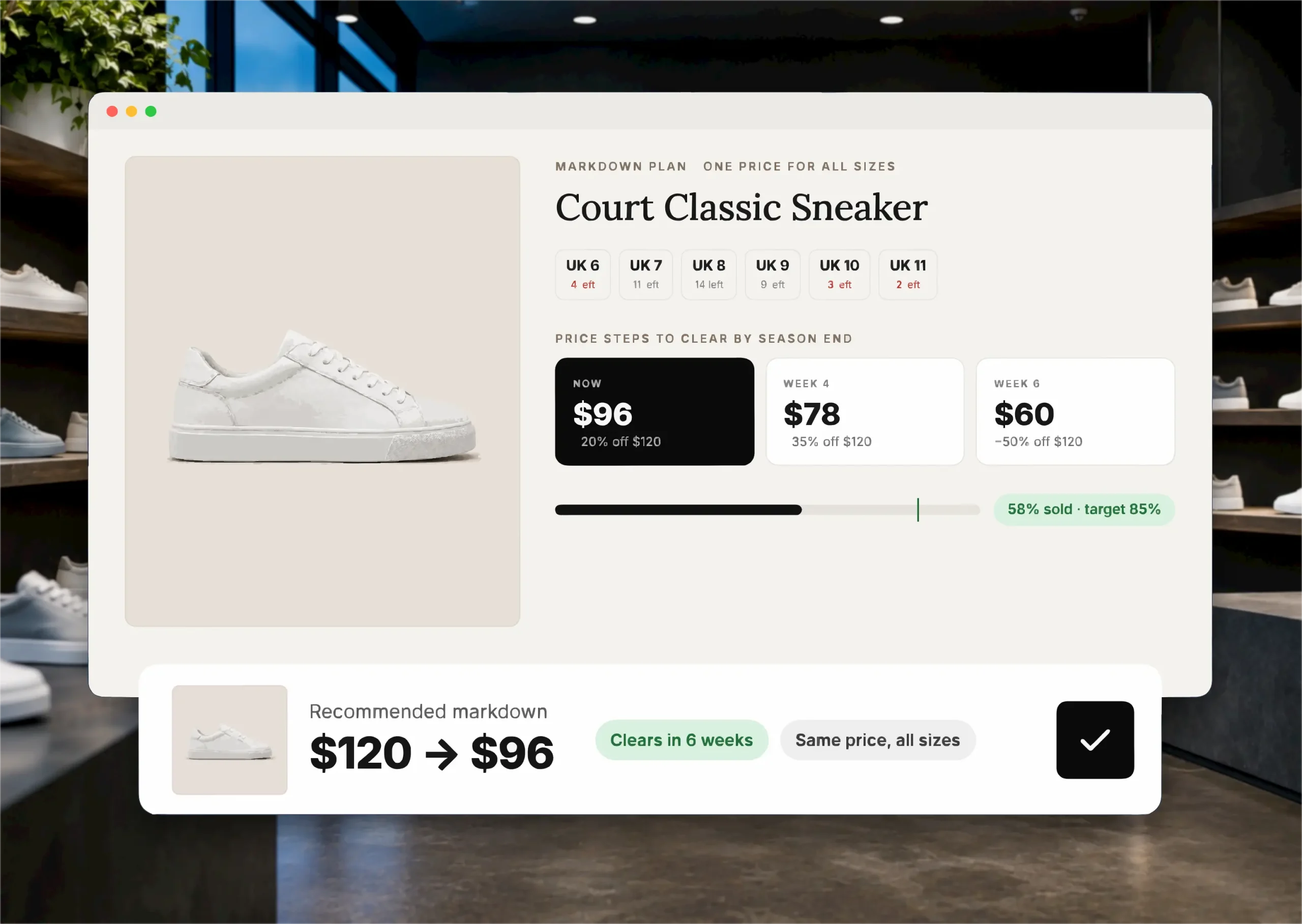
When only a few sizes are stuck, the whole style shouldn’t go on sale. Discount just the leftovers.

Stock piles up in some stores and runs short in others. Markdowns follow what each store holds.

New stock needs the space. Markdowns are timed so old stock sells through by your exit date.
Clearance shouldn’t be a guessing game played at season end. Look inside how Growdhi tracks sell-through, sets the right depth, targets the right stock, and measures what each markdown recovered.
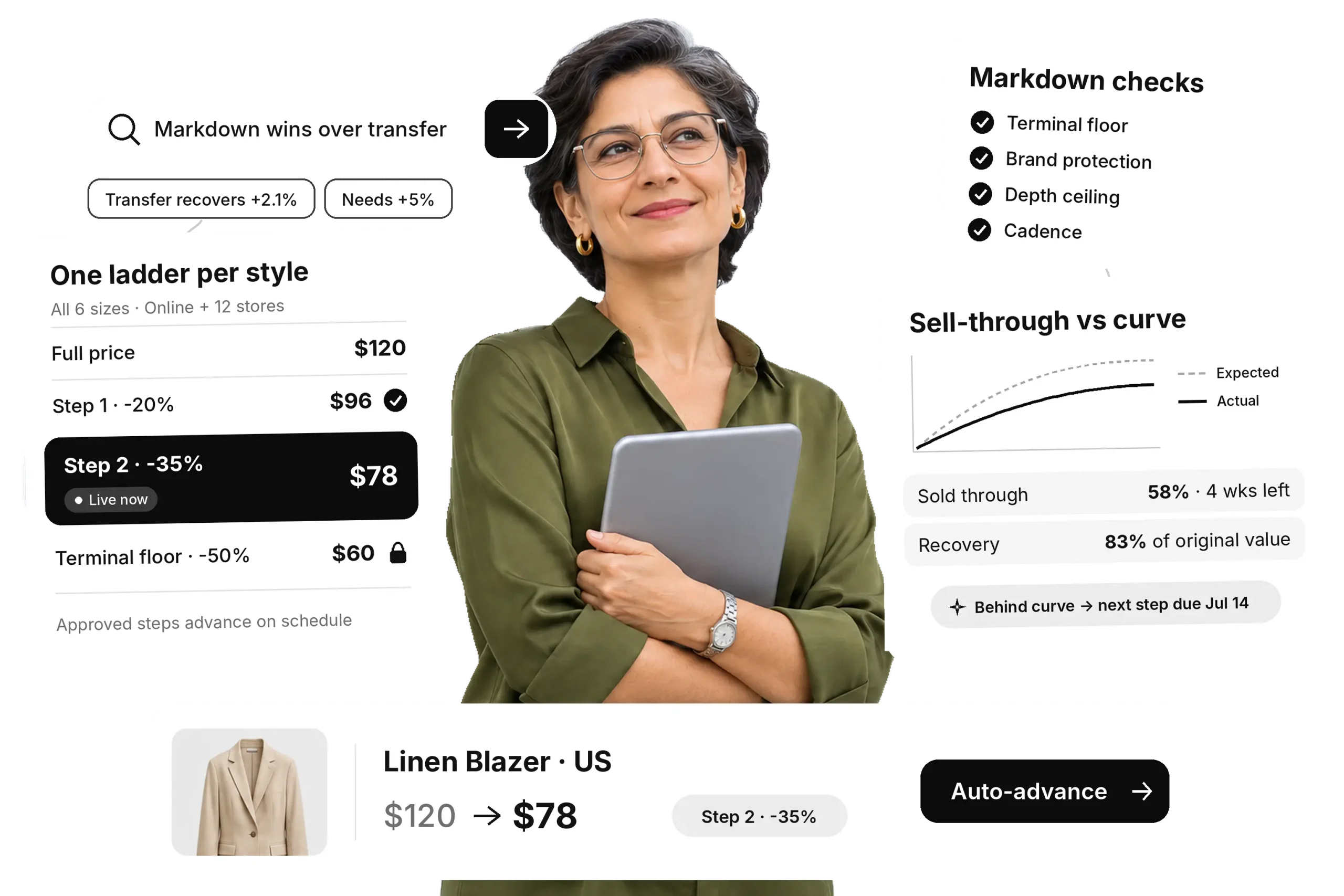
Sell-through is the share of your stock that has sold so far. Growdhi compares it with where each item should be by now, and flags those falling behind.
Shoppers respond very differently to 10% off and 40% off. Growdhi estimates the response to find the smallest markdown that still clears stock in time.
Slow stock is rarely spread evenly. Growdhi pinpoints the exact sizes, colors, and stores that need a markdown, and leaves the rest alone.
Clearance works best with a clear finish line. Set exit dates and floor prices, and Growdhi plans the steps to get there.
After a clearance, the question is how much value you got back. Growdhi measures it and brings the lessons into next season’s plan.
 Stock stops selling
Growdhi's Markdown

Before any cut, checks whether moving stock to a store that still sells it at full price would recover more, after freight.

Each style gets planned steps: how deep, how long each lasts and a ceiling for the season. Every size takes the same price, same day.

The next cut comes only when sales fall behind plan, never below your cost floor, and judged on real sales, not promotion-boosted ones.
Product age, stock and true landed cost from Inventory • Open-to-buy from your financial plan Live promotions from Promotions • Starting price from Dynamic Pricing
While a ladder is live, its price wins over promotions and the everyday price.

Each step posted online, with notices for every store

Stops reordering stock that is being cleared

Clearance stock for end-of-season events


Built for businesses that carry seasonal or short-life stock, Markdown Management adapts to your products, stores, and clearance deadlines.

Fashion & Apparel
When popular sizes sell out, the rest linger. Discounting only the leftover sizes clears them while the style holds full price.

GROCERY & HYPERMARKET
Short shelf life leaves little time to react. Timely, store-level markdowns move fresh items before their date runs out, instead of writing them off.

SPECIALTY STORE
Slow-moving stock can sit for months, blocking space for new arrivals. Planned exit markdowns clear it on schedule, without heavy end-of-season discounts.
A space to explore ideas, spark perspectives, and turn curiosity into clarity. Where thinking evolves into meaningful insights that guide smarter decisions.

 Blog
Every fashion retailer commits money to product months before it knows what customers will buy. This guide explains how fashion margin is made and lost, how business models place that bet, and how leaders use AI in 2026.
Read Article Blog
Grocery is the one retail segment where a bad decision can expire before anyone reviews it. Margins run at a few cents on the dollar, fresh stock lasts days, and shoppers return every week to test whether the store still delivers value. Most enterprise grocers already own capable systems for forecasting, pricing, ecommerce and loyalty. […]
Read ArticleFind quick answers to common questions about our solutions, features, and capabilities. Everything you need to understand how it works and how it helps your business.
It decides when to discount slow-selling stock, by how much, and where. Instead of one large end-of-season sale, you get a series of smaller, well-timed markdowns that clear stock while protecting margin.
When it’s selling too slowly to clear by its exit date. Growdhi compares each item’s sell-through with where it should be and flags those falling behind, often weeks before a manual review would.
No. Markdowns start only when an item falls behind schedule, begin at the smallest effective discount, and stay above the floor prices you set.
Yes. Recommendations can target individual sizes, colors, stores, or channels, so you discount only the stock that’s actually stuck.
It sits within Price IQ alongside Pricing and Promo Optimization, so clearance never clashes with everyday prices or offers. It also uses the Plan IQ demand forecast to judge how fast each item is likely to sell.