Start a Conversation

Forecast accuracy from day one. Plan inventory around what will sell.

Plan IQ is a foundation-model forecasting engine that works zero-shot on your catalog from the first day and gets sharper every week after.

Plan IQ

What does this solve?

Wrong inventory plans can cause huge losses. When demand forecasting is backed by data and market insights, and product assortment is optimized with inputs from financial planning, it ensures better margin per category. Plan IQ aligns demand, inventory, and pricing strategies in one go. Most forecasting tools need months of clean data before they're useful. Yours doesn't have to wait that long.

Here’s how Plan IQ turns these outcomes into reality.

  • Demand forecasting is accurate.
  • Inventory strategies are optimized.
  • Assortments deliver better margins.
  • Budget is allocated the right way.

What's inside Plan IQ: Agents

Planning is no longer just a spreadsheet; it's a critical growth driver. Plan IQ helps you stay ahead with smarter, data-driven planning decisions through our autonomous solutions like Demand Forecasting, Assortment Optimization, and Merchandise Financial Planning (MFP).

Demand Forecasting

Demand Forecasting

Demand Forecasting

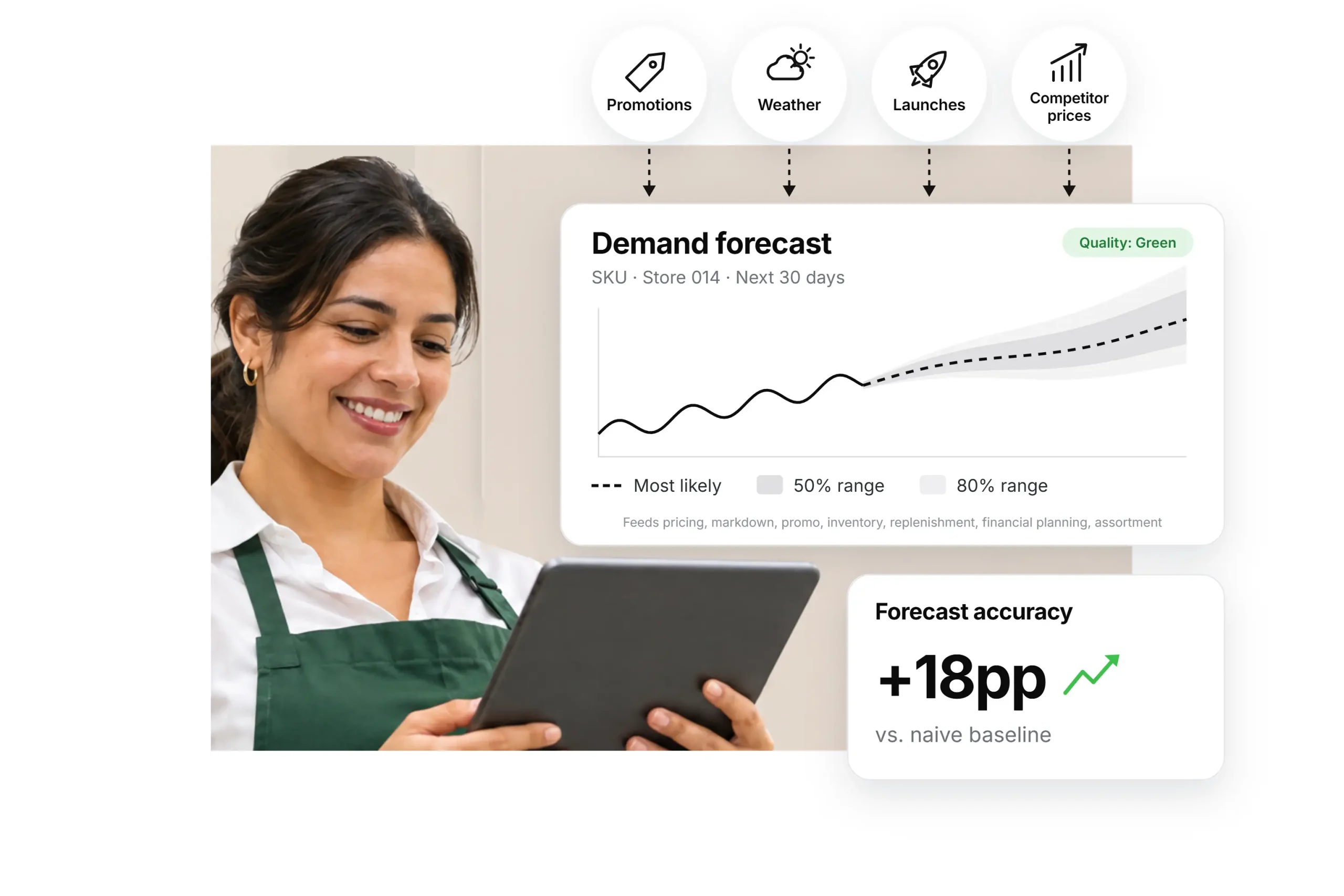
Predict demand accurately to optimize inventory and sales.

  • It works from day one with no historical data: it runs zero-shot on your catalog, with no multi-month onboarding.
  • It forecasts at SKU-location level across 1 to 90 day horizons, with confidence ranges (conservative/median/upside), not one flat number.
  • It reacts automatically to real signals, such as promotions, weather, launches, and competitor prices.
  • It gets more accurate every week as it fine-tunes on your data, with no manual retraining.
KPI: Cash flow improvement, margin
Explore Demand Forecasting

Merchandise Financial Planning

Merchandise Financial Planning

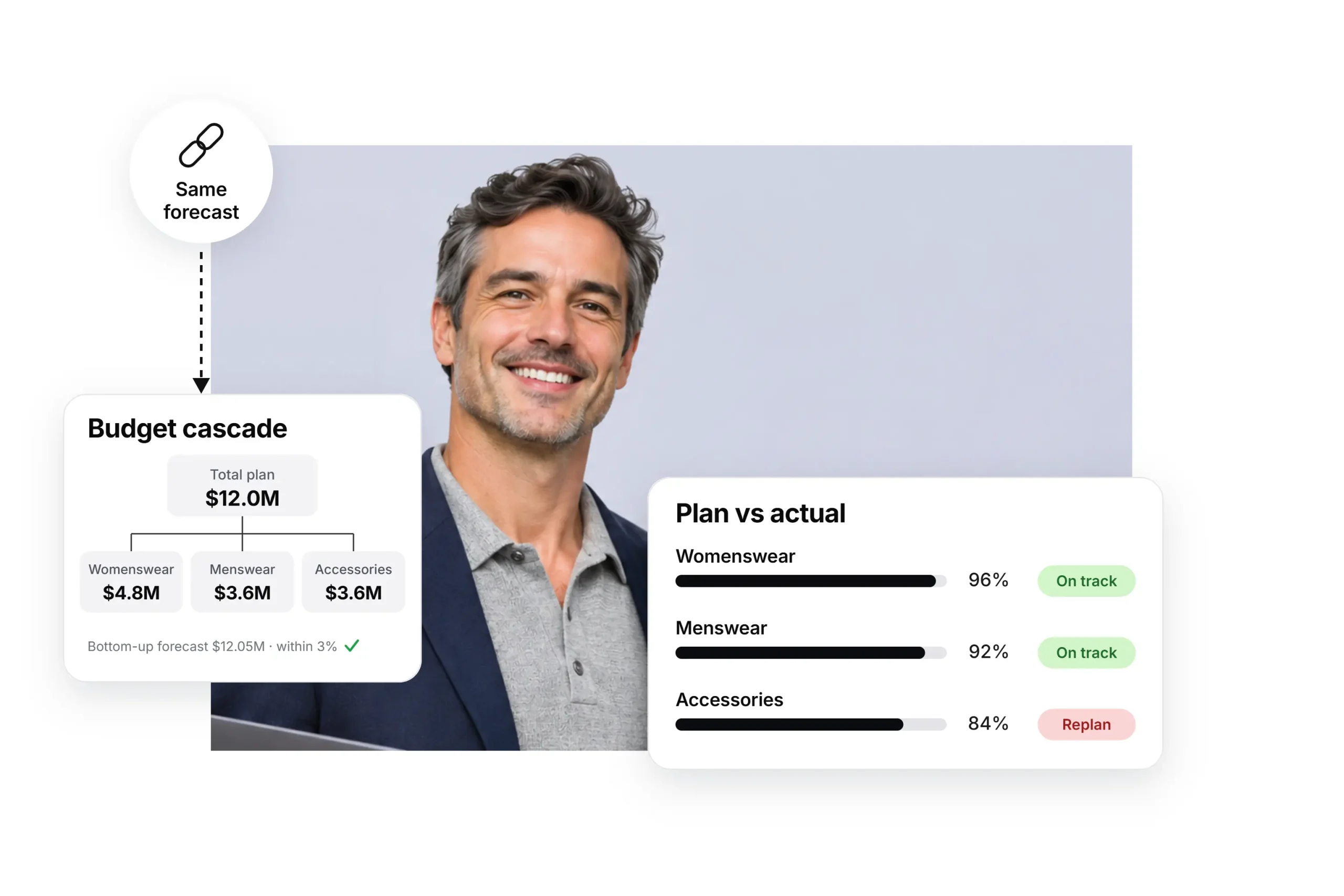
Plan merchandise investments aligned with financial goals.

  • Top-down budget targets are cascaded to category, brand, and market and tracked in real time against actuals.
  • It runs on the same forecast, with no separate, disconnected planning spreadsheet.
KPI: Resource allocation, margin
Explore Merchandise Financial Planning
Merchandise Financial Planning
Assortment Optimisation

Assortment Optimisation

Assortment Optimisation

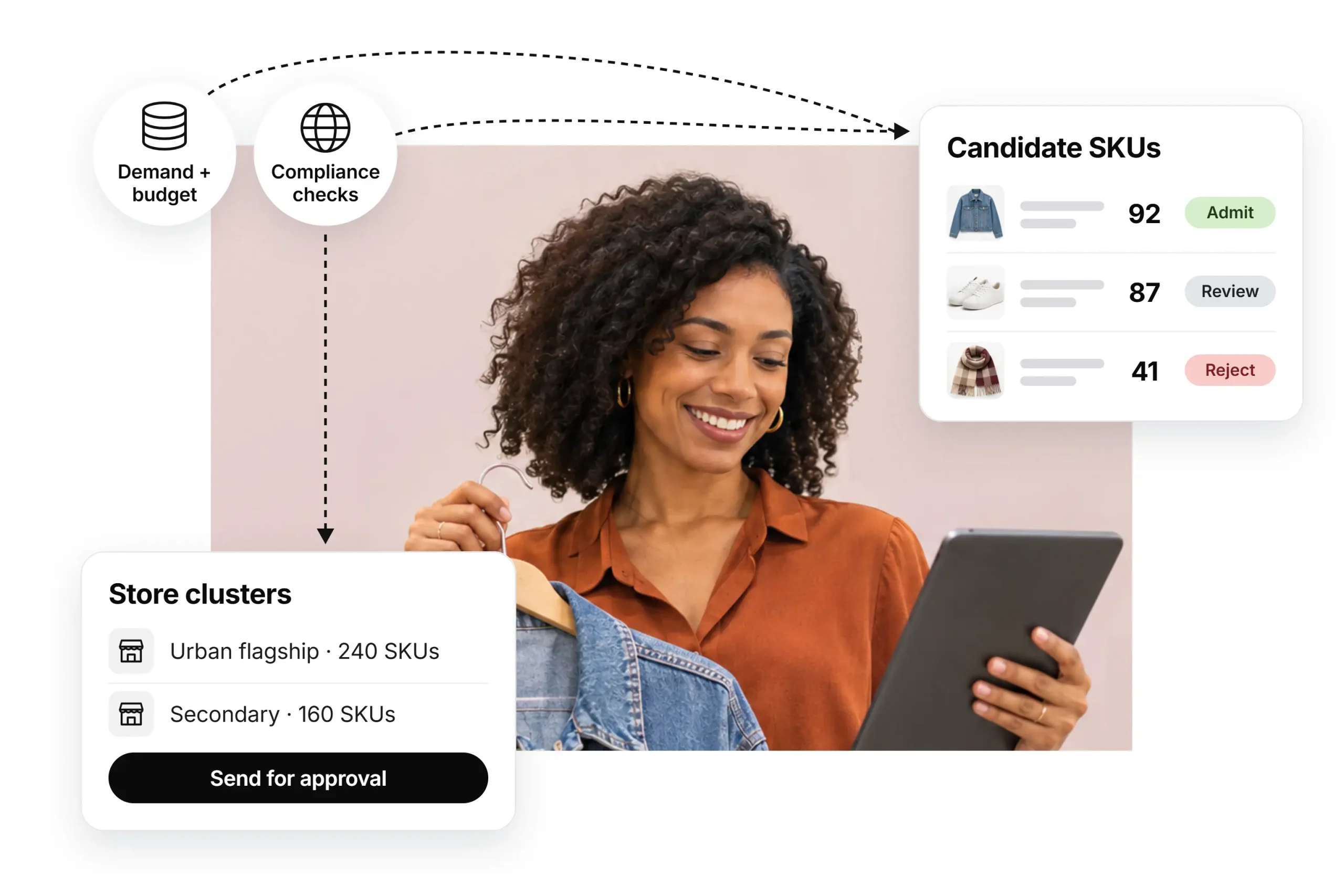
Curate product assortments to maximize sales and margins.

  • It scores every candidate SKU, including ones you don't currently carry, against demand potential, margin, and shelf space.
  • Store-level clustering means a store location and a neighborhood store each get the range that fits their customers, not one chain-wide list.
  • Cultural and regional compliance checks are built in for local markets.
KPI: Resource allocation, margin
Explore Assortment Optimisation

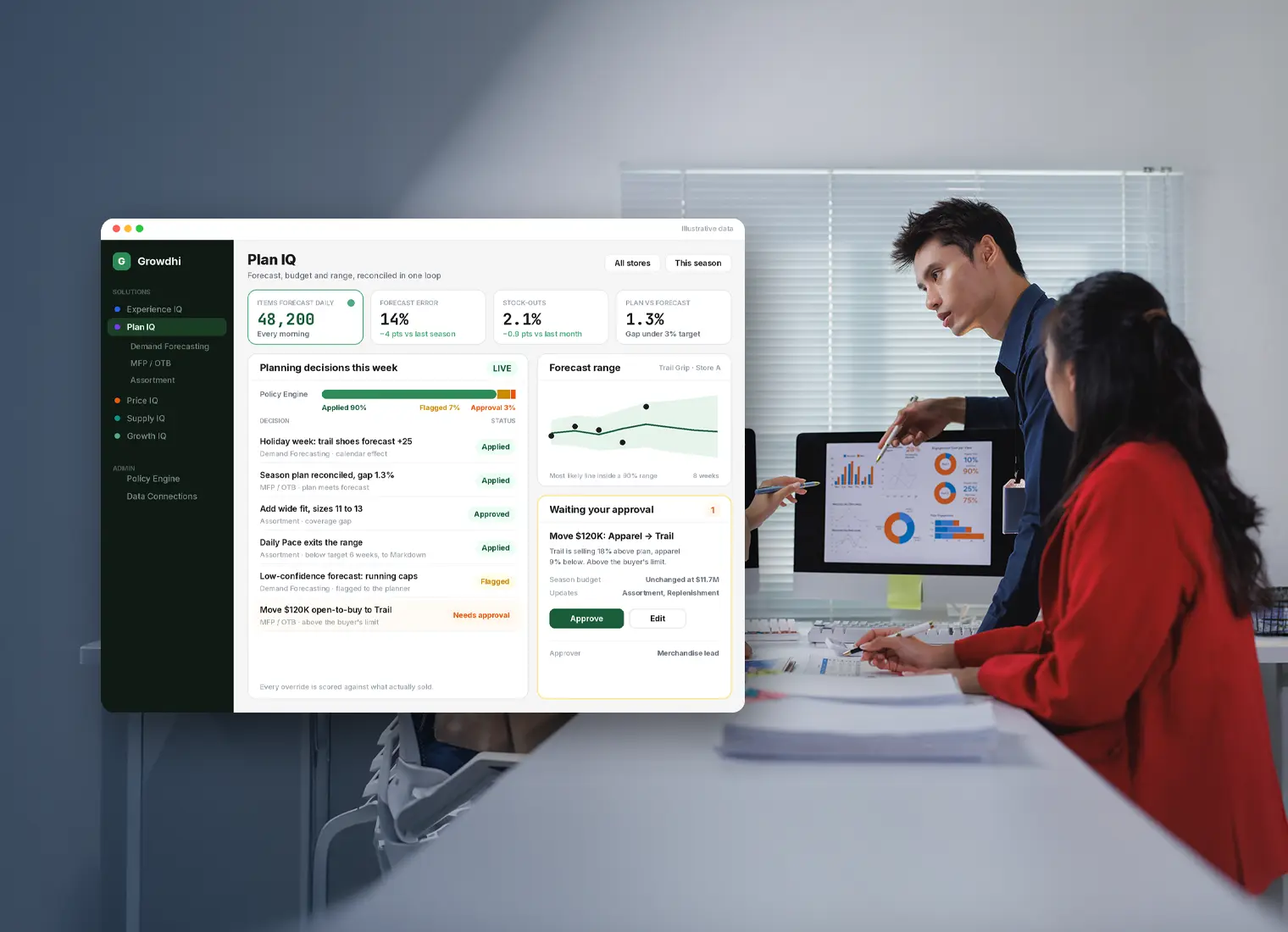
See Plan IQ in Your Planning Workflow

See how Plan IQ fits your planning workflows, goals, and business needs. Understand how it works with your catalog and data to drive smarter decisions.

How it Works

Planner starts season Planner starts season

Growdhi's Plan IQ

Demand Forecasting

Demand Forecasting

SKU-level demand updated daily, per store

Demand · Forecast
Assortment Optimisation

Assortment Optimisation

Right SKUs, right stores, right depth per cluster

Range Plan
MFP / OTB

MFP / OTB

Turns plans into buy budgets that protect margin

OTB consumption · lead times · plan variance from Supply IQ · Price changes from Price IQ

Signals Passed to other IQs

Plan intelligence powers other IQs across the platform.

Experience IQ

Experience IQ

New range availability

Growth IQ

Growth IQ

Category demand trend

Supply IQ

Supply IQ

Demand Plan & OTB Budget

Price IQ

Price IQ

Demand forecast · seasonal trend

Business Outcomes

Business Outcomes

30–50%
30–50% Stockouts
under 10%
under 10% Forecast error

Life with / without Growdhi

Forecasting
Forecast Confidence
Connected Planning
Store-Level Planning
Scenario Planning

Without

New forecasting tools need months of data before they're useful.
One flat forecast number, with no sense of best or worst case.
Forecast, pricing, and replenishment tools each learn separately.
Assortment decisions are made chain-wide, ignoring local differences.
Planners react after a stockout or markdown, not before.

Where Strategy Meets Execution

Built for industries where demand forecasting directly impacts inventory, margin, and cash flow. Plan IQ adapts to your business model and market dynamics.

Two people shopping at a clothing rack

Fashion & Apparel

Buying for trend and cultural fit

Short seasons and fast trends make every wrong buy expensive, and markets such as the UAE and KSA add modest-fashion compliance to each range.

Plan IQ accounts for trend velocity and cultural fit together, so buyers stop cross-checking every SKU by hand.

Two people shopping at a clothing rack

Grocery & Hypermarket

Keeping planners on real exceptions

Grocery moves at the highest SKU velocity of any vertical, and buying is already close to fully automated.

Plan IQ keeps the forecast accurate enough that planners spend their time on true exceptions rather than second-guessing a model that is usually right.
Two people shopping at a clothing rack

Specialty Store

Ranging for one store's customers

In a small, curated catalog, one wrong buy costs more than anywhere else.

Plan IQ scores demand potential for every SKU at store level, so it catches what a chain-wide list would miss.

FAQs

Plan IQ is Growdhi’s AI merchandise planning suite for retailers. It combines three agents: Demand Forecasting predicts what will sell, Merchandise Financial Planning sets open-to-buy budgets, and Assortment Optimization decides which products to carry in which stores. Top-down financial targets and bottom-up forecasts are reconciled before each season. During the season, any change in demand flows through to budgets, ranges and replenishment.

AI demand forecasting learns from sales history and the signals that drive demand: calendar events, weather, price, promotions, inventory and product lifecycle. Plan IQ uses Chronos-2, a time-series foundation model, to forecast each product by store and day. Every forecast includes a likely value plus a low and high range. Forecasts refresh daily and recalculate during the day when prices change, stock runs short or a weather alert is issued.

New products are forecast by comparing them with similar existing products. Plan IQ matches each new product to existing ones by attributes such as category, style and price band. It can derive attributes from the product image and description when catalogue data is incomplete. This gives every new product a forecast from day one, and Plan IQ switches to the product’s own sales history after about 30 days.

Open-to-buy is the budget a retailer has left to spend on inventory for a period, after accounting for planned sales and current stock. Plan IQ sets seasonal open-to-buy budgets by category, channel and season, and reserves budget for markdowns and promotions. It allocates spend where the expected margin return is highest. It also checks actual demand against the plan weekly and triggers a replan when the gap becomes significant.

AI assortment optimization treats every shelf or range slot as limited capacity and fills it with the products expected to earn the most. Plan IQ adds a product only when its expected gross margin beats the next-best use of that slot. It plans ranges for store groups (such as flagship, secondary and outlet stores) and makes sure customers can find the key attributes they look for. It also uses basket data to keep products that are bought together.

Yes. In Plan IQ, planners can override, annotate and explain any forecast. The system measures whether each override improved accuracy, so the model learns from planner judgement and planners can see where they tend to over- or under-forecast. Forecast quality metrics such as MAPE and WAPE are visible for every forecast. Other agents can be set to reject low-quality forecasts automatically instead of acting on them.